Key Design Principles
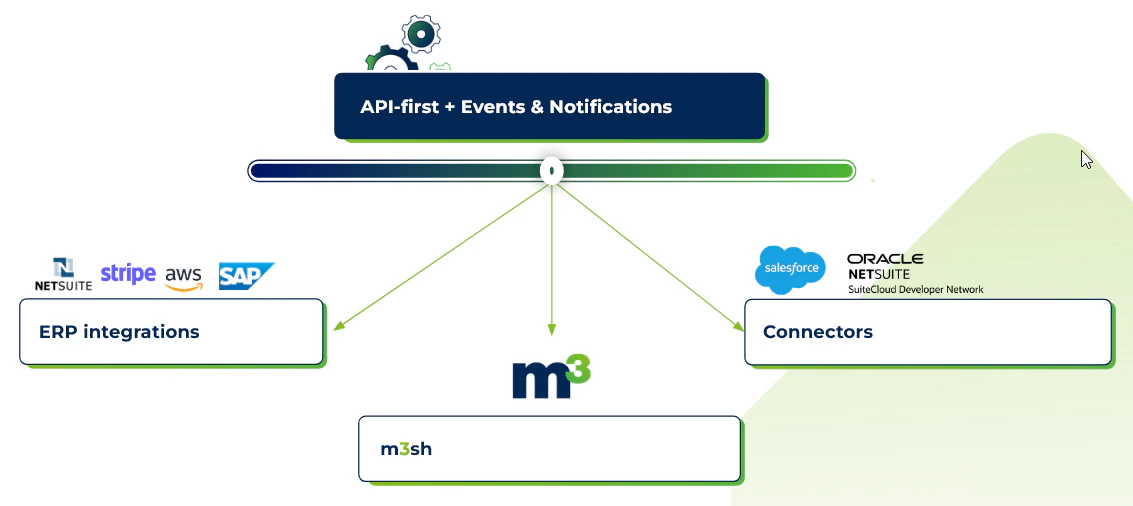
The m3sh platform is built around three key design principles to ensure a smooth end-to-end rating and billing flow through your quote-to-cash stack:Interoperability and Connectivity
A baseline requirement was to ensure the capability to plug easily and seamlessly into existing systems:- Input of data:
- From CRM systems for initial and ongoing set up and configuration.
- From SaaS platforms for end-customer product usage data.
- Output into ERP systems to support invoicing and analytics reporting across multiple systems.
Customer Stack: Accommodate and Enhance
It was considered vital that implementing m3sh made no change demands on existing customer tech stacks:- Can be deployed either as the source of truth, or as a headless platform.
- No system migrations should be needed to incorporate m3sh in the stack.
- Stack can evolve around m3sh - graduate ERPs, consolidate CRMs, add and remove other components - m3sh will adapt.
- No 3rd-party IPaaS necessary, leading to more robust IT governance.
Exploit and Enhance m3ter
From the outset, a core objective was for the m3sh platform to extend and strengthen the value proposition of m3ter:- Can be directly hooked into m3ter configuration and functions to complement and strengthen the platform’s capacity to address and fulfill evolving operational billing and analytical needs.
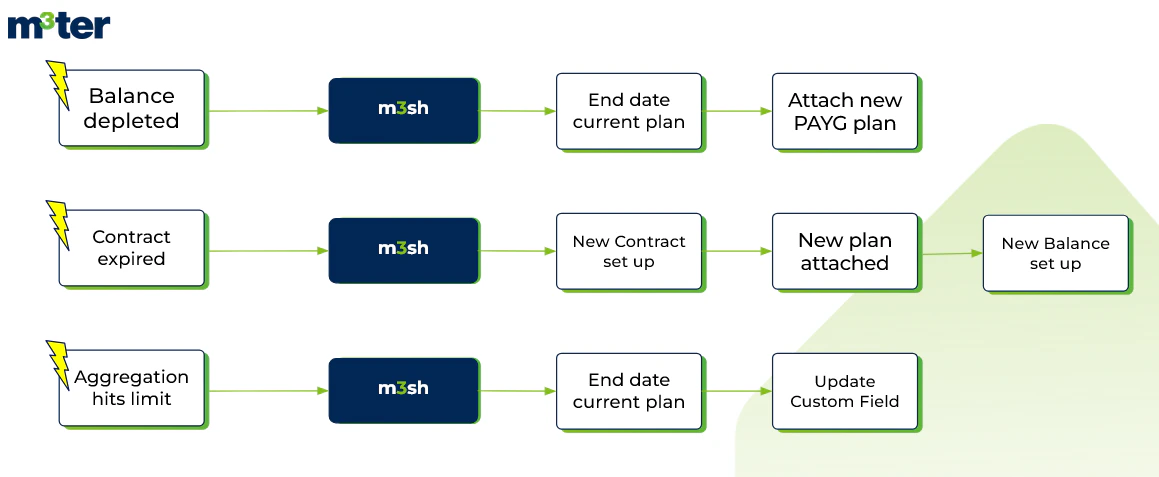
- m3sh triggers for automated update and management of key billing entities in response to defined end-customer account events, such as balance depletion or contract expiry.
Common Use Cases
m3sh can be used to fulfill several common use cases:- Multiple ERP: Invoicing to Multiple Endpoints
- Unified Billing for Diverse Products and CRMs
- Automated Plan and Contract Management with m3sh Triggers
Multiple ERP: Invoicing to Multiple Endpoints
For this use case, m3sh mediates and orchestrates data flows between the customer platform, Salesforce, m3ter, AWS, and NetSuite to implement multi-endpoint invoicing with enrichment and alerting: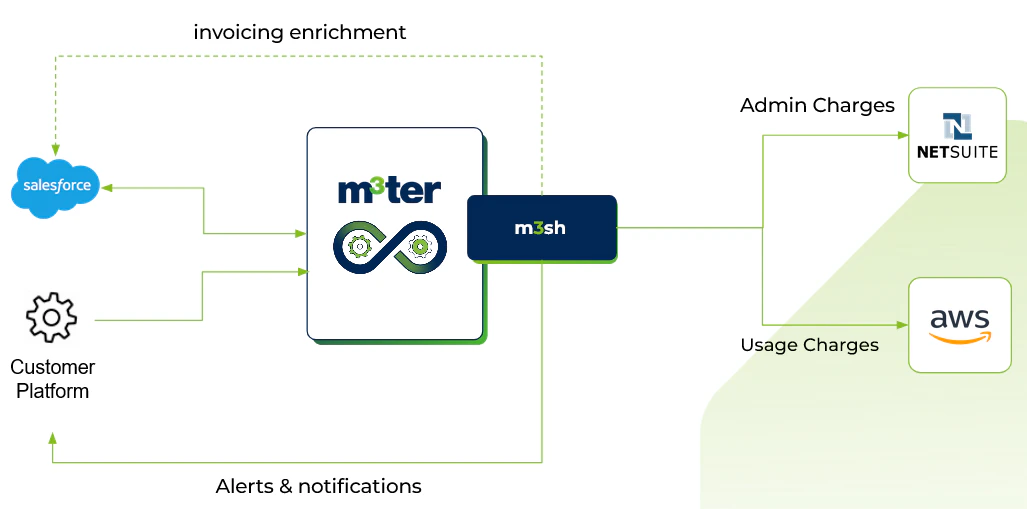
Unified Billing for Diverse Products and CRMs
For this use case, m3sh allows you to consolidate usage data and/or contract data from different CRMs - Salesforce and HubSpot - and from your customer platforms to enable centralized metering and rating for multiple products: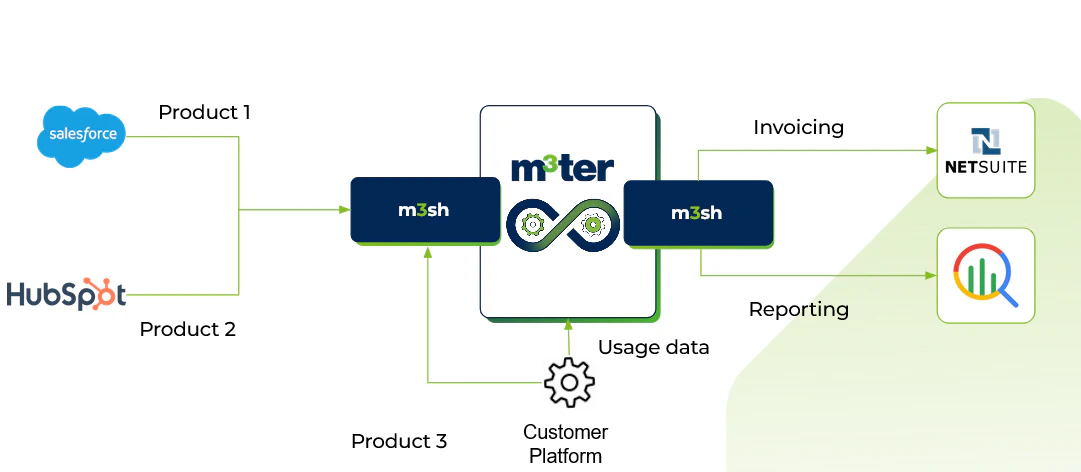
Automated Plan and Contract Management with m3sh Triggers
For this type of use case, m3sh triggers are set up to automate actions like plan switching, balance resets, and custom field updates in response to events such as balance depletion, contract expiry, or imposed usage limits: